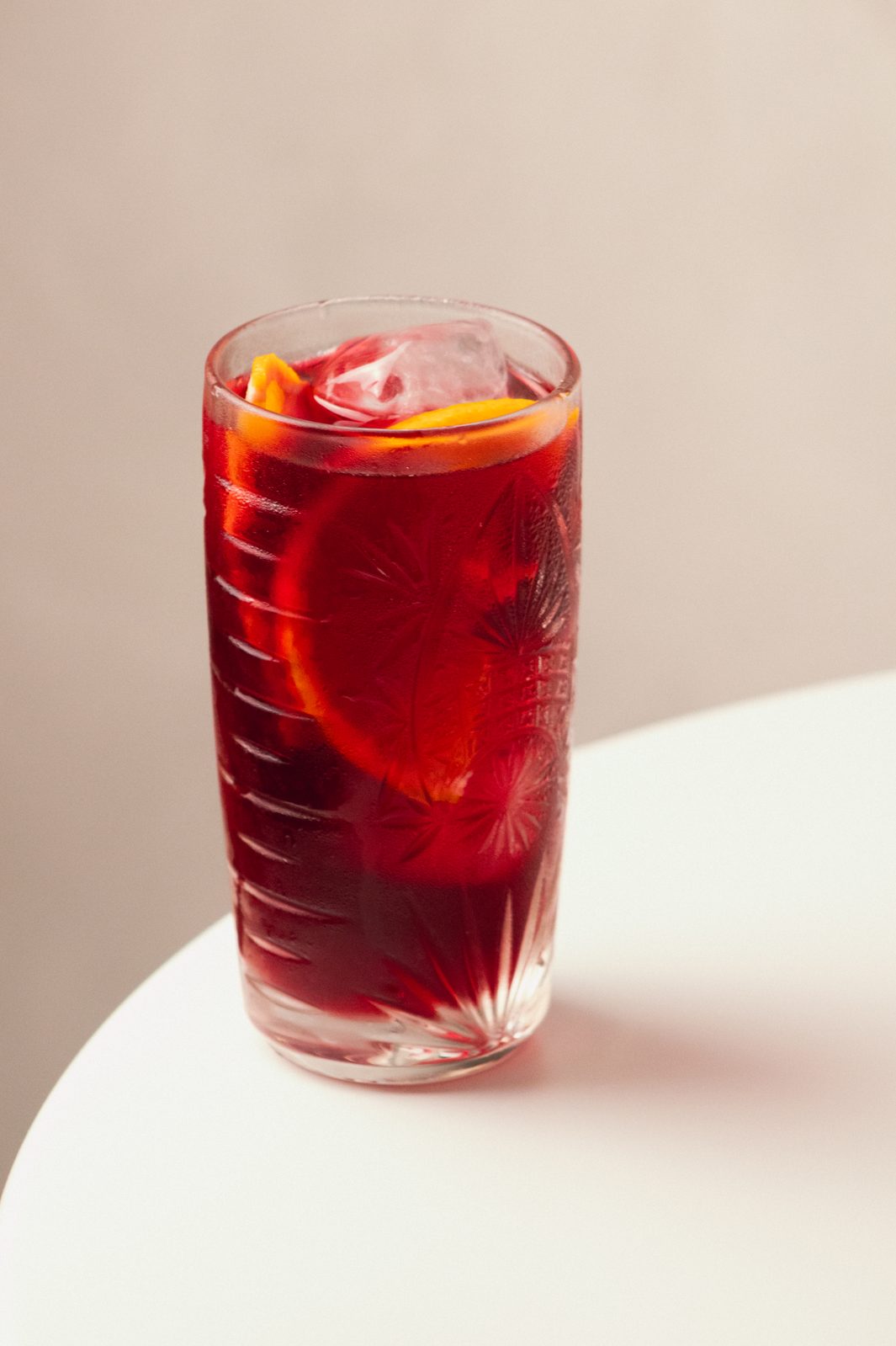
Before we started the restaurant, I rarely paid much attention to iced tea in restaurants.
Whenever I ordered one, it was usually not really worth the money. It would be advertised as homemade, and somehow that became the argument for making it expensive. Even though tea, water, fruit and sugar cost much less than almost any bottled soft drink—especially with the sugar taxes on those drinks.
The margin on iced tea is just very good for restaurants.
At home, though, I was already making a lot of black tea with lemon. I liked the simplicity of it. In summer, I could keep a whole pitcher in the fridge and always have something cold and refreshing that wasn’t full of endless sugar and preservatives.
So that became one of our first homemade drinks at the restaurant. We use organic black tea, lemons from the Algarve and agave syrup instead of white sugar. It is simple, but when it is cold and the balance is right, it is exactly what I want from an iced tea.
The second one was hibiscus.
A friend introduced me to it years ago. Hibiscus tea is a thing in Iran, and when I was still living in Germany, I used to buy big bags of the flowers from an Iranian supermarket.
I didn’t do a lot of research before putting it on the menu. I just liked it. It tasted completely different from the black tea, had this strong red colour and gave customers a choice.
Then, after a few months of running the restaurant, I started paying much more attention to what other restaurants were doing.
And suddenly, hibiscus iced tea was everywhere.
Hip taco places in Stockholm, surfer cafés, açaí bowl places—basically every restaurant trying to look young, cool and good on Instagram had a big glass of red iced tea somewhere.
That made me curious about what else we could do.
There is nothing wrong with hibiscus iced tea. It is refreshing, it looks great and it is cheap to make. I understand exactly why everybody offers it. We do too.
But it made me think about what a homemade drink at a restaurant could be. Maybe we can offer an alternative that people actually crave. A non-alcoholic drink that is exciting enough to stand next to the food and that is genuinely worth the extra money people usually pay for the word “homemade.”
I don’t want our drinks to be something people order only because they don’t want a Coke. I want someone to look at the menu and think: What is that? I want to try it.
That is how hibiscus iced tea got me interested in punch.
Punch is not really one specific drink. It is more of a way to build a drink by combining fruit, tea, sweetness, acidity, herbs and spices. It can contain alcohol, but it doesn’t have to.
That is what interests me. There are endless combinations to explore, and the result can be more indulgent than iced tea. It can have more texture, more layers and flavours that people don’t already know from every other café.
My first try started with pears from a friend’s garden.
I cooked them for around an hour until they had almost the consistency of marmalade. Then I put some of this pear base in a glass and poured tea over it.
The first one was way too sweet. The tea already had sugar in it, which was obviously not very smart. But I didn’t really care, because I could taste that there was an idea in there.
It wasn’t finished, but it already felt like something I wanted to keep exploring.
Now I want to try different teas with the same pear base. I want to add herbs, play with the acidity and find combinations that make the pear more interesting without completely hiding it. Maybe it needs spice. Maybe it needs something bitter. Maybe the whole pear idea goes nowhere.
That is the part I like.
I want to explore the world of cool non-alcoholic drinks and find out how far we can take them. Drinks with the same thought and excitement behind them that we try to put into our food.
I don’t have a recipe to finish this article with, and I don’t have the new drink ready yet. For now, it is just the beginning of the experiment.
The hibiscus iced tea will stay. People like it, and I still like it too.
But now it has made me curious about what comes next.